Your background bridges engineering, project delivery, and business leadership. How has that shaped how you approach problems?
I consider myself a people-first engineer, and my background across engineering, project delivery, and business leadership has really shaped how I approach problems by forcing me to think beyond the technical solutions and focus on the people and outcomes behind them. My approach to problem solving has always been more collaborative in nature, and I think that's what set me up to be successful in leadership, leading teams, leading programs, leading projects. Having broad exposure in the AEC space over many years has enabled me to think about problems in terms of impact and value creation. As the industry evolves, I am beyond excited for the opportunity to combine these perspectives to create positive outcomes.
Where do projects most often start to go sideways?
Usually you can solve any problem if you work together. Projects usually go sideways early when there’s misalignment on outcomes and expectations. That’s when people start protecting themselves instead of solving problems together. I have worked throughout my career to create strong communication, shared visibility, and earlier risk detection which has helped my teams stay aligned and address issues before they escalate. Technology is helping to enable this. For me it's a combination of building alignment and trust early, and using technology to reinforce it every step of the way.
What process problems has the AEC industry simply learned to live with?
Quality control. Peer review. The whole QC process, really.
The reality is, projects are more complex than ever, with more stakeholders, tighter schedules, and massive amounts of documentation. So, QC becomes compressed, inconsistent, or treated as a checkbox instead of what it should be: a critical risk management function.
What that means in practice is: either you don't feel like you have enough time to do proper QC, or you do it but it's not as comprehensive as it should be, or things get surfaced and then deferred to a later date. At this point, it's not a people problem, it's a scale problem. We’re asking humans to manually review thousands of pages under time pressure, and it's just not realistic. Nobody in the industry likes this, by the way, but we’ve simply had to learn to live with it.
What kinds of issues look small early but become expensive or problematic later?
My background is in mechanical and plumbing engineering, so I'll give you one I've seen again and again: startup and commissioning issues.
You've got all the equipment installed. Water heaters, electrical, mechanical systems, all in. Then comes the day it gets turned on. And that's when you tend to get a whole slew of issues, because either things weren't installed correctly, or systems don't work together the way the drawings said they would. The issues that cause chaos on opening day were almost always visible in the documents months earlier. They just got ignored because they felt minor, or far away, or less pressing than whatever felt more urgent that week.
The problem is, startup and commissioning sits at the intersection of every system and every decision, and failures there are both common and costly. Getting a certificate of occupancy, opening a restaurant, getting tenants into an apartment building: the stakes are very real. Those small deferred things have a way of becoming very dramatic at exactly the wrong moment.
Where can AI meaningfully reduce friction in AEC today? And where is human judgment still essential?
Design is inherently iterative. If you could just decide what you wanted and draw a building, that would be different, but that's not what the design process is. It involves a lot of iteration and decision making, and thinking through how one decision has a kind of snowball effect on other decisions you have to make down the road.
What excites me about AI is the ability to help people make those decisions more effectively, and really understand the downstream impact before it's too late to change course. What AI does really well is compress that loop. It can generate options, test constraints, calculate accuracy, and review quality much earlier so teams can make better decisions before they become expensive to change, creating fewer blind spots and less rework.
Human judgment is still essential anywhere there’s context, relationships, and nuance. So, I see it as a partnership with AI helping us see more and decide faster, with people still responsible for choosing wisely with real-world context aligning others around that decision.
What drew you to LightTable?
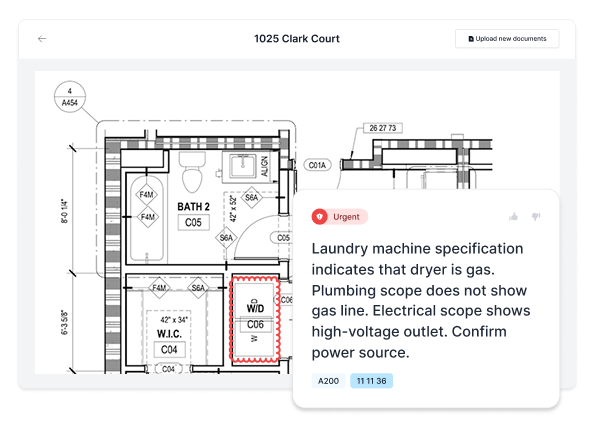
I’ve spent a lot of time building QA/QC processes and trying to catch issues early, and the reality is the current system is slow, manual, and inconsistent. LightTable is tackling that directly—using AI to review thousands of pages in minutes and surface issues early, before they turn into rework, delays, and change orders.
But what really stood out to me is the mindset behind the company. There’s a real intellectual honesty about how early we are in this AI shift, and a willingness to learn from customers and evolve toward what actually creates value.
That’s rare—and it’s exciting.
The bigger thing for me, though, is the opportunity to help the industry stop repeating the same mistakes. I’ve spent close to 20 years seeing the same issues show up across different teams and projects, and this feels like a chance to finally break that cycle. Not eliminate mistakes—but at least make new ones.
How does your experience in project delivery shape how you think about LightTable's role in the process?
I've worked on hundreds of projects with different teams across design, construction, and development. What that gives you is a very real picture of where pain actually lives, not in the abstract, but in the hours. Hours in meetings trying to make a single decision. Hours in meetings after something went wrong, trying to figure out what happened. That's a real cost. Real time. Real stress on people.
My perspective at LightTable is rooted in having seen those challenges firsthand: the pain points that development and construction teams feel when executing a project, and what it actually costs when things go sideways, not just financially, but in terms of the human energy that gets consumed by problems that should have been caught earlier. That shapes how I think about where LightTable can catch problems early.
So for me, LightTable isn’t just about faster review, it's about reducing the hidden cost of rework and firefighting, reducing risk, protecting margin, and ultimately improving project outcomes.