Jene Alie has seen construction from every angle. She spent two decades as a practicing architect, then moved into construction litigation, worked the owner/developer side, and led projects from the GC side. At each stop, she saw the same problems: communication breakdowns, preventable errors, and issues surfacing too late to fix affordably.
Now she's at LightTable, bringing that hard-won perspective to help teams catch problems early. We sat down with Jene to talk about what she's learned, what surprised her about AI, and why she believes better tools can actually make the industry better.
Q: You've worked as an architect, in litigation, for owners, and for contractors.You’ve seen projects from every side. Where do things actually break?
Almost always, it comes back to communication.
Most of the disputes I’ve worked on could have been addressed much earlier if people were actually talking to each other in a productive way. On paper, most issues are easy to fix. Even once you’re out in the field, many things are still fixable. But once people get emotionally entrenched in their position, it becomes very hard to move forward.
A lot of my career has been spent acting as a translator between teams. Helping the design team understand what the contractor actually has to work with. Helping contractors understand what the designer is trying to achieve. When that translation doesn’t happen early, people dig in. And once that happens, you lose the ability to solve problems together.
Q: What mistakes look small on paper but explode in real life?
Repetition is the killer.
You might have a detail in the drawings that seems minor. It looks like a small coordination issue or a simple miss. But if you’re working on a hotel with 400 or 500 rooms, that same issue repeats hundreds of times. A small mistake multiplied at that scale becomes a massive cost and schedule problem.
Less experienced teams often underestimate this. They see a $200 issue and don’t realize that it turns into a $50,000 problem very quickly when it repeats across an entire project. Until you’ve lived through that, it’s hard to fully appreciate how careful you need to be with things that seem simple.
Q: What surprised you most about what AI can catch?
The kinds of issues it catches. It catches the scope gaps far better than I would have thought. It catches constructability issues much better than I would have thought. It understands the sequencing of construction and potential productivity impacts, much better than I thought.
I’d expect it to be good at conflict checks. There's lots of other software out there that does conflict checks. But the scope gaps and the constructability issues are really where the cost is.
Those obvious conflict checks, you'll find those generally before stuff goes in. It's the constructability issues where you get halfway through building something and realize there’s a problem. You can't do this after that, now you have to tear it all out and come back and rebuild it.
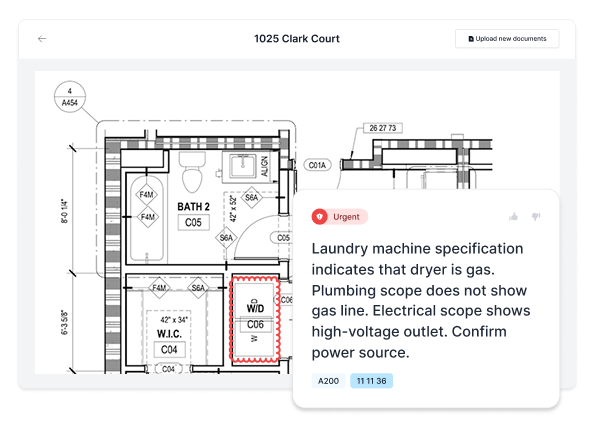
The scope gaps, like large format tile on a PT slab without floor leveler specified. You may not find that until the tiles are cracking. So now you have to rip all that material out and redo it. Those are the things that cost more time and money. And I never thought that AI would catch that kind of stuff. I thought that's the kind of thing that takes experience, lessons learned the hard way, but the AI can help teams avoid that pain.
Q: Where does human expertise still matter most?
Judgment. Technology can help find issues much faster than people can. What it gives experts back is time. Time to think about how to resolve an issue, rather than spending time trying to find it.
The solution is where experience really matters. Understanding what worked and what didn’t in the past. Knowing what tradeoffs are acceptable. Being able to prioritize what actually needs to be removed and replaced versus what can be managed in other ways.
The real value of expertise is not in spotting the problem. It’s in deciding what to do about it.
Q: What made you join LightTable?
I've been trying to find a way to make the industry better my entire career. In construction litigation, I could opine on what went wrong but I couldn’t affect project outcomes. That didn't sit well with me.
So I kept moving. Owner side, to see if I could help make better decisions. Contractor side, to facilitate communication between teams. Each time, I learned more about where the system breaks. But none of it had the reach to actually fix things at scale.
When Graham talked to me about LightTable, what appealed to me was the idea that we could help facilitate communication across the entire project team. That we could bring issues to the surface early, so teams can actually address them when the fix is easy.
I want everybody in this industry to be able to make money, build great projects and have a great experience. A job that lets you start from just an idea and have it result in the places where people live life? That's worth fighting for.